


Last week I had the privilege of helping Sam Charlton launch the first Planning for Profit School in the United Kingdom. Seventeen progressive farmers from Scotland, England, Germany, and even a couple from here in the U.S. gathered in Crieff, Scotland for the five day program built on the Ranching for Profit curriculum.
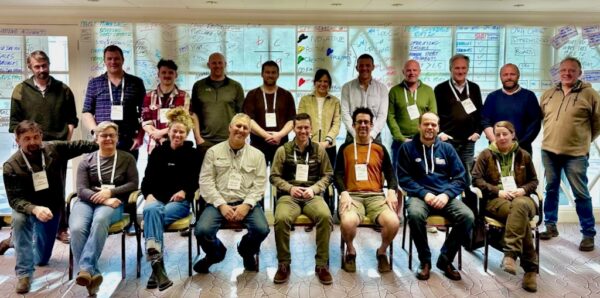
Sam made the bold decision to license our Ranching for Profit material and brought the program to UK producers. And if I’m honest, I felt a little nervous walking into that room.
Would the material resonate?
Would the principles hold up across different policies, different weather patterns, and different cultures?
Would our time-tested principles about management and profitability make sense in an agricultural system that is very different from North America?
I’m happy to report: principles can swim.
But here’s the bigger takeaway for North American ranchers: if the principles work there, they work here.
The Problems Aren’t Geographic
As the week in the UK progressed and trust grew, the conversations deepened at the Planning for Profit School. Beyond the accents and the currency differences, the challenges producers faced were nearly identical to what I hear from ranchers across North America:
- Getting the family aligned around a shared vision.
- Building a business that produces real economic profit, not just tax management.
- Cash flowing operations in volatile markets.
- Finding capital for expansion without strangling the business.
- Helping outgoing leadership transition with dignity.
- Preparing incoming leadership with real management skills, not just operational competence.
- Evaluating enterprises objectively in the face of weather and market uncertainty.
- Creating time for strategic management while buried in daily tasks.
Sound familiar?
These are not Scottish problems. They’re not English problems. They’re not even “ranching” problems. They’re business problems. And business principles don’t change with the outfit of the ag producer.
The Hard Truth for Ranchers
Sometimes we convince ourselves our situation is unique.
“Our markets are different.”
“Our land is different.”
“Our regulatory environment is different.”
There’s nuance, of course. But nuance doesn’t negate principle.
If a grazing enterprise doesn’t generate enough gross margin that justifies the investment of time, money or land, it doesn’t matter what country you’re in. If overheads are bloated, no passport will save you. If leadership is unclear, the team won’t succeed in pounds sterling or U.S. dollars.
The fundamentals that determine long-term success are universal:
- Long term profit is a result of deliberate design, not good luck.
- Cash flow is oxygen.
- Management time must be scheduled before it gets consumed.
- Clear roles prevent family conflict.
- Capital must earn its keep (produce a good ROI).
- Enterprises must be profitable.
Those principles all held up in Scotland just fine.
Why This Matters at Home
For North American ranchers, this should be encouraging and challenging.
Encouraging because it proves that solid management transcends geography. If others can adopt disciplined business thinking in a completely different system, so can we.
Challenging because it removes excuses.
If producers operating under tighter land bases, heavier regulation, and different subsidy structures can improve profitability through better management, then we have no reason to settle for mediocre returns masked by asset appreciation.
The opportunity in North American ranching is enormous. We operate in one of the most resource-rich agricultural environments in the world. But resources without management create complexity not profit.
The Power of Expanding the Net
As Sam grows Planning for Profit in the UK, I’m excited about what this means for ranchers here at home. The cross-pollination of ideas strengthens everyone. Our long-standing relationship with RCS Australia has proven that international collaboration sharpens thinking. Different climates force different adaptations but the core principles remain intact.
When ranchers from different continents wrestle with the same management questions, it reinforces something powerful:
This is about leadership.
This is about clarity.
This is about intentional design of a profitable business.
Not location.
It shouldn’t be any surprise that the Ranching for Profit principles apply across diverse landscapes and cultures. They were, after all, largely developed by our founder Stan Parsons from Zimbabwe (formerly Rhodesia). He brought his teachings to North America, attracting ranchers and farmers from all over. In this video you can hear Stan in his own words, recorded in Australia as he was teaching the Ranching for Profit principles.
Principles can swim. The question is, will we?
Where have you traveled and experienced very different environments and cultures only to realize the root challenges are the same? Or did you find it different than I did? Leave a comment below with your experience.




I’m a cattle producer in Middle Tennessee. I went to RFP in Reno in 2025 believing what all my neighbors had told me. That is, the Southeast has unique issues, other environments have it easier/harder, it’s different here. I came back from RFP realizing, we all have the same issues. 80% of those issues are people issues, at that. I’ve come back and applied the RFP principles to our ranch, my electrical service business, our restaurants, and we are starting a small hospitality business. We’ve also taken a few things OFF the plan, because I came back able to have an objective look at the numbers for existing and new enterprises.
Long story short; I’m excited for those in the UK who have the opportunity to learn these principles. I’m also thankful for how serious RFP takes their own course.