

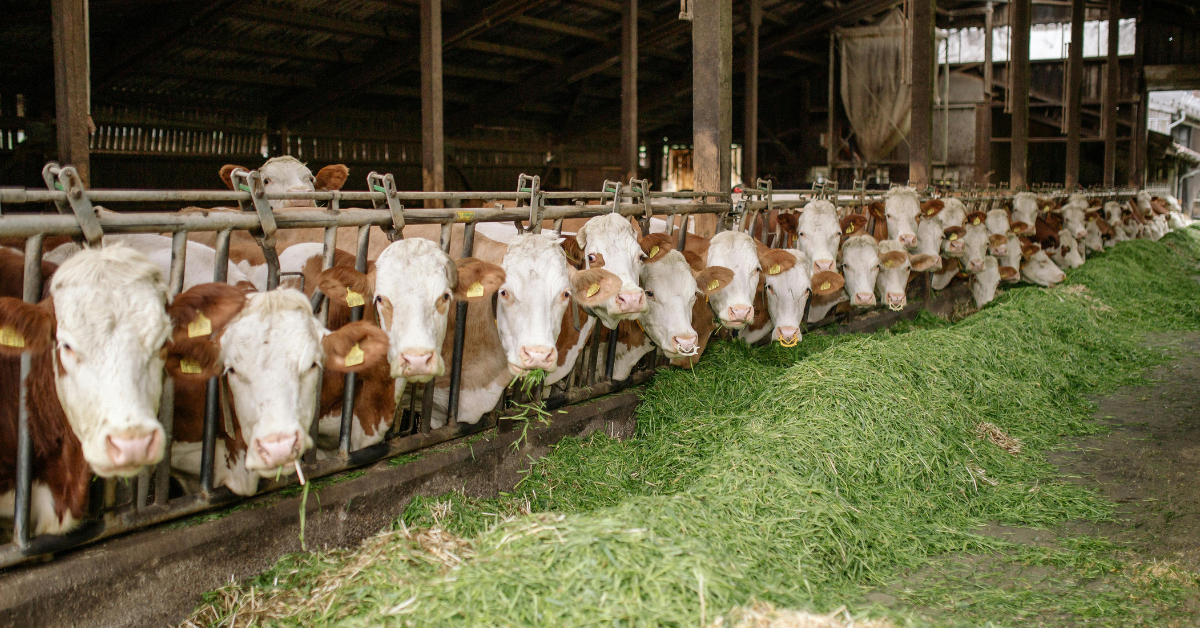
It’s tempting to chase the path of reducing inputs to increase profit. In some cases it works. In other cases it can make the business less profitable. Which can be surprising to some folks because inputs that didn’t make sense a few years ago when the market was different might make sense today, and vice versa. This can seem confusing but we have a way to help answer the question: is this input a good decision?
At Ranching for Profit we teach there are three ways to increase profit in any business: reduce overheads, improve the gross margin per unit, and increase turnover. We cover each of these in detail at the Ranching for Profit School. Let’s look deeper at gross margin. In plain terms, gross margin is the value you produce, minus the direct costs of production. A direct cost is one that increases proportionally as units increase. If you add one more cow and the cost goes up by one increment, that’s a direct cost. Divide gross margin by the units of production and you have gross margin per unit, or GM/U.
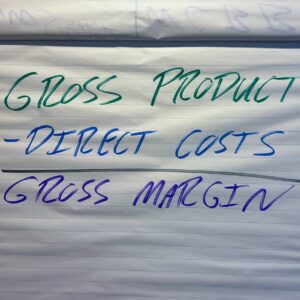
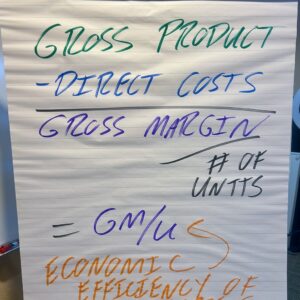
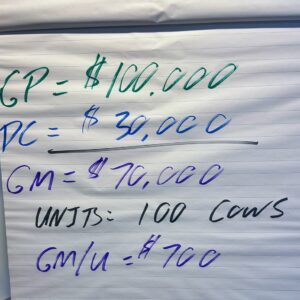
This is a critical number to know for your operation. GM/U tells you the economic efficiency of the enterprise, and it lets you compare enterprise A to enterprise B.
When you’re considering cutting or adding an input, the first test is simple: what does that change do to GM/U? If I take away or add the input and GM/U goes up, I’m interested in looking deeper. If it goes down, I’m not interested.
Here’s how to run that test on your own operation this fall.
- First, list your direct costs by enterprise, not by ranch total. Feed, mineral, vet work, AI, and trucking all belong here if they scale with head count.
- Second, price out the change. If you’re weighing whether to drop a mineral program or add a vaccination protocol, put a number on what it costs per head and what it’s worth per head in performance.
- Third, run it through GM/U, not through your gut. If GM/U goes up, dig deeper. If it goes down, walk away, even when the input sounds smart on paper.
There seem to be two camps in ranching: those chasing production and those chasing low cost. I don’t think either camp is right 100% of the time. The high production game without cost control is a wreck. In all my years of working with ranchers and farmers, I’ve never seen the most productive ranch be the most profitable. In fact, it’s often inversely correlated. The ranch with the highest conception rates, biggest calves, and fanciest cattle is usually propped up with income from another source. It makes for good bragging rights, but the next time someone brags about production metrics, remind yourself: production and profit are not correlated in ranching.
Now let’s look at the other side: only chasing cost reduction. For this example, let’s talk about direct costs — things like feed, mineral, vaccinations, AI (the semen kind not the Claude kind), and so on. These things add up. They’re a significant part of the total cost of running a ranch. Let’s start whittling away at direct costs. There are probably some direct costs we can take out of most ranches without much impact on production, but at some point the risk of a wreck or a real production decline sets in. The test, again, is to watch GM/U. When GM/U drops, that’s usually a sign you’ve gone too far. As always, there’s more to the story than fits in a short article like this. Direct costs are tied to overheads. To deliver inputs you incur the cost of delivering them. We call those overheads: facilities, equipment, people, and stuff. Overhead creep is a constant threat.
In today’s market, some direct costs that didn’t pencil out a few years ago may make sense today. And with input costs changing this fast, some direct costs that make sense today won’t necessarily make economic sense down the road. It is important to remember that the relationships are constantly changing. Keeping your finger on gross margin per unit gives you the information you need to make sound decisions throughout the ups and down of any market.



Great article! “ I don’t think either camp is 100% right every time.” Great comment. Human behavior is the greatest profit driver.